

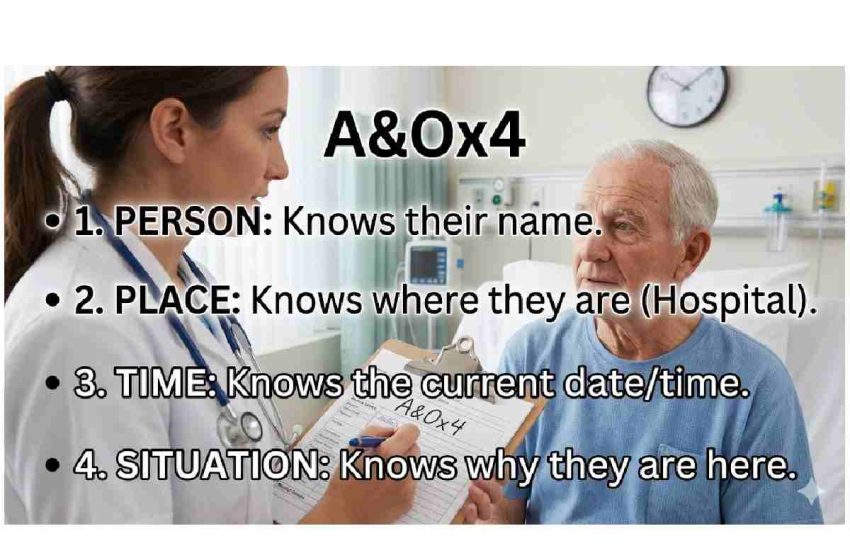
A&Ox4 Meaning: Understanding Alert and Oriented Times Four in Healthcare
Most times, folks working in U.S. clinics, ERs, elder care spots, or ride-along crews jot down quick medical shorthand when checking someone’s state. A standout phrase tossed around – especially when things get tense – is called A&Ox4, seen plenty during head checks or urgent field moments.
Waking up somewhere familiar helps. Someone noticing the time without checking a clock – that kind of awareness counts. Clarity shows in how questions get answered, smooth and steady. Spotting confusion early makes a difference down the line. Knowing your name, location, date, and situation isn’t just routine – it reflects deeper function. Medical staff listen closely when responses come fast and make sense. Sharp thinking tends to reveal itself through these small moments
Spotting confusion, brain issues, head trauma, infections, or quick shifts in thinking often hinges on this assessment. Though small, its impact stretches across many urgent concerns – quietly shaping outcomes behind the scenes.
Table of Contents
What Does A&Ox4 Mean?
The abbreviation breaks down into two parts:
- Alert = the patient is awake and responsive
- Oriented x4 = the patient understands four important orientation areas
A patient who is fully A&Ox4 can correctly identify:
- Who they are
- Where they are
- The current date or time
- Why they are receiving care or what situation is happening
Medical references explain that A&Ox4 is considered one of the strongest indicators of normal cognitive awareness during basic neurological evaluations.
The Four Orientation Categories in A&Ox4
1. Orientation to Person
This checks whether the patient knows their identity.
Common Questions
- What is your full name?
- What is your date of birth?
This is usually the most basic orientation level and often the last one lost during cognitive decline.
2. Orientation to Place
This determines whether the patient knows their current location.
Common Questions
- What hospital are you in?
- What city are we in?
3. Orientation to Time
This measures awareness of time-related information.
Common Questions
- What year is it?
- What day of the week is it?
Healthcare professionals note that confusion about time is often one of the earliest signs of cognitive problems. 4. Orientation to Situation
This checks whether the patient understands why they are receiving medical care.
Common Questions
- Why are you here today?
- What happened before arriving here?
A&Ox4 Assessment Table
| Orientation Area | Purpose |
|---|---|
| Person | Confirms identity awareness |
| Place | Confirms environmental awareness |
| Time | Confirms awareness of date and time |
| Situation | Confirms understanding of current events |
A&Ox4 Awareness Chart
Person Awareness        ████████████████
Place Awareness         ██████████████
Time Awareness          ████████████
Situation Awareness     ██████████
Why A&Ox4 Assessments Matter
Healthcare providers rely heavily on A&Ox4 evaluations because mental status changes may signal serious medical emergencies.
A sudden drop in orientation may indicate:
- Stroke
- Brain injury
- Dementia
- Delirium
- Drug overdose
- Severe infection
- Low blood sugar
Medical resources explain that orientation assessments provide quick insight into neurological function and patient safety.
Difference Between A&Ox1, A&Ox2, A&Ox3, and A&Ox4
Patients are not always fully oriented.
| Level | Meaning |
|---|---|
| A&Ox1 | Oriented only to self |
| A&Ox2 | Oriented to self and place |
| A&Ox3 | Oriented to self, place, and time |
| A&Ox4 | Fully oriented to person, place, time, and situation |
Healthcare references describe A&Ox4 as the highest orientation level in routine mental status checks.
Situations Where A&Ox4 Is Commonly Used
Emergency Rooms
Doctors use rapid orientation checks during emergencies.
Ambulance Assessments
Paramedics often evaluate orientation immediately after accidents or medical emergencies.
Nursing Care
Nurses monitor orientation throughout hospitalization.
Post-Surgery Recovery
Confusion after anesthesia can affect orientation.
Elderly Care
Older adults are monitored closely for cognitive decline.
Healthcare Settings Using A&Ox4
| Medical Setting | Purpose |
|---|---|
| Emergency departments | Neurological evaluation |
| Intensive care units | Monitor brain function |
| Nursing homes | Cognitive tracking |
| Ambulance services | Rapid assessment |
| Post-operative care | Detect confusion |
Difference Between Alertness and Orientation
Many people assume these terms mean the same thing, but they are different.
Alertness
Measures wakefulness and responsiveness.
Orientation
Measures awareness and understanding.
A patient may be awake but still confused or disoriented.
Conditions That May Affect A&Ox4 Status
Neurological Conditions
- Stroke
- Concussion
- Brain trauma
- Alzheimer’s disease
Metabolic Problems
- Dehydration
- Low blood sugar
- Electrolyte imbalance
Mental Health Conditions
- Severe anxiety
- Psychosis
- Delirium
Substance-Related Causes
- Alcohol intoxication
- Drug overdose
- Medication side effects
Common Causes of Altered Orientation
Head Injury            ██████████████
Dementia               ████████████
Drug Intoxication      ██████████
Stroke                 █████████
Low Blood Sugar        ███████
Infections             ██████
How Medical Staff Perform an A&Ox4 Assessment
The evaluation is usually performed through direct questioning.
Healthcare providers observe:
- Speech clarity
- Eye contact
- Response speed
- Accuracy of answers
The process typically takes only a few minutes but provides critical neurological information.
Example of A&Ox4 Documentation
Medical charts may include notes such as:
- “Patient alert and oriented x4”
- “A&Ox3 with confusion about situation”
- “Disoriented to time and place”
These records help healthcare teams track mental status changes over time.
A&Ox4 and Brain Health Monitoring
Monitoring orientation is extremely important after:
- Head trauma
- Falls
- Seizures
- Surgery
- infections
A sudden decline in orientation may require immediate medical attention.
A&Ox4 vs Glasgow Coma Scale (GCS)
Healthcare providers sometimes use both assessments together.
| Feature | A&Ox4 | Glasgow Coma Scale |
|---|---|---|
| Focus | Mental awareness | Consciousness severity |
| Method | Orientation questions | Numerical scoring |
| Use | Cognitive evaluation | Trauma assessment |
A&Ox4 in Elderly Patients
Older adults may temporarily lose orientation due to:
- infections
- dehydration
- medication reactions
- dementia
Healthcare teams closely monitor these changes because confusion can rapidly worsen without treatment.
Misconceptions About A&Ox4
Myth 1: Awake Means Fully Alert
A patient may appear awake but still be disoriented.
Myth 2: Memory Loss Always Means Dementia
Temporary confusion can occur from infections or medication side effects.
Myth 3: A&Ox4 Measures Intelligence
The assessment only measures awareness and orientation.
Tips for Family Members and Caregivers
Families should watch for sudden mental changes such as:
- Confusion about location
- Forgetting familiar people
- Trouble answering simple questions
- Sudden personality changes
Immediate medical attention may be needed if symptoms appear suddenly.
Mental Status Monitoring in U.S. Healthcare
Across America, hospitals place strong emphasis on brain assessments since spotting disorientation or mental changes sooner helps people recover better. Though subtle at first, shifts in thinking are often caught through routine checks that quietly guide treatment decisions forward.
Rapid mental status assessments help healthcare providers respond faster during emergencies
Future of Cognitive Monitoring
Modern healthcare systems are improving neurological monitoring using:
- AI-assisted patient monitoring
- digital cognitive assessments
- remote neurological tracking
- electronic health record alerts
These tools may upgrade early detection of neurological decline in the future.
Conclusion
Sometimes called A&Ox4, this phrase checks if someone knows themselves, their location, what day it is, because context matters too. Health workers like doctors or EMTs watch for clear thinking by using these four clues during fast evaluations. Knowing your name might seem basic – yet slipping on any point can signal trouble in the brain’s wiring. Where you stand, literally, ties into awareness just as much as recognizing today’s date does. Why you’re getting help rounds out the picture, since purpose connects to comprehension. If one piece feels off, professionals take note – it may hint at injury, disorientation, or deeper issues unfolding slowly.
This test shows up a lot in ERs, clinics, hospitals, and care facilities since shifts in alertness might point to big health problems. Because someone knows what A&Ox4 means, they follow doctor notes easier, family talks make more sense. Watching how clear a person thinks stays key across American medicine – keeps people safer, speeds up treatment when needed, supports healing down the road.